
If you run a local business — a restaurant, a dental clinic, a law firm, a plumbing service — and people in your city cannot find you on Google, you are losing customers every single day. That is not an overstatement. It is what happens when local SEO is ignored.
This guide explains exactly what local SEO is, how it works, and why it is one of the highest-return investments a small business can make in 2026.
What Is Local SEO?
Local SEO (Local Search Engine Optimization) is the process of optimizing your online presence so that your business appears in search results when people search for products or services near their location. It covers everything from your Google Business Profile to your website content, online reviews, and local citations across directories.
When someone types “dentist near me,” “best biryani in Dhaka,” or “plumber in Mirpur” into Google, local SEO determines which businesses appear — and where they appear — in those results.
Unlike traditional SEO, which competes on a national or global scale, local SEO targets a specific geographic area. The goal is simple: show up when a nearby customer is ready to spend money.
How Local SEO Works
Google uses three primary factors to rank local businesses: relevance, distance, and prominence.
Relevance means how well your business profile matches what the person searched for. If someone searches for “AC repair service,” Google needs to confirm your business actually offers AC repair — not just that you are an electronics shop.
Distance means how far your business is from the searcher’s location (or the location they specified in the search). A closer business often ranks higher, but it is not the only factor.
Prominence means how well-known and trusted your business appears based on signals across the web — reviews, backlinks, directory listings, and mentions.
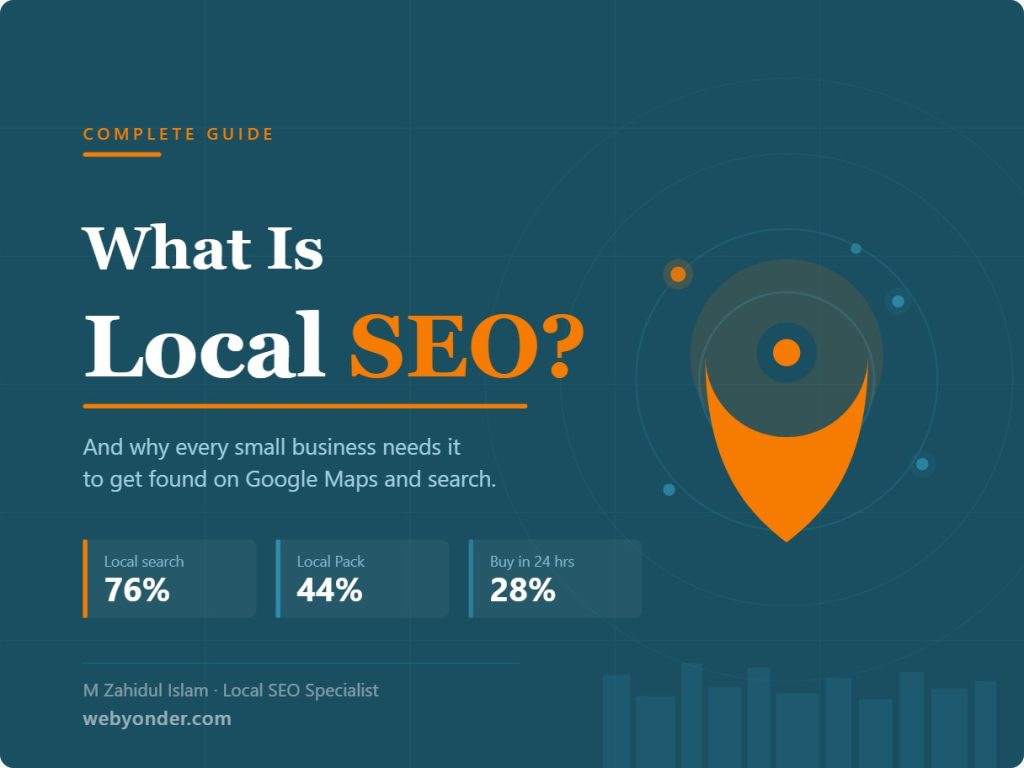
When all three align, your business earns a spot in what Google calls the Local Pack — the map section with three business listings that appears at the top of local search results. Studies show the Local Pack captures over 44% of all clicks on a local search results page.
Local SEO vs. Traditional SEO
| Factor | Local SEO | Traditional SEO |
|---|---|---|
| Target audience | People in a specific city, area, or region | National or global audience |
| Primary ranking tool | Google Business Profile | Website authority and content |
| Key ranking signals | Reviews, proximity, citations | Backlinks, domain authority |
| Search intent | High purchase intent (“near me,” “in [city]”) | Mixed intent (informational to transactional) |
| Time to results | 4 to 12 weeks for Local Pack visibility | 3 to 12 months for competitive rankings |
| Best for | Service businesses, retail, restaurants, clinics | E-commerce, SaaS, publishers, national brands |
Most small businesses benefit from both, but for service-area businesses, local SEO delivers faster results and more directly qualified traffic.
Why Every Small Business Needs Local SEO
1. The Majority of Customers Start With a Search
According to Google, 76% of people who search for something nearby on their smartphone visit a related business within 24 hours, and 28% of those searches result in a purchase. When someone searches for a nearby service with the intent to hire or buy, they are not browsing — they are deciding.
If your business does not appear in that moment, a competitor takes the customer.
2. Local Search Dominates Mobile Traffic
Mobile searches with “near me” intent have grown by over 500% in the past five years. People are searching for local businesses while commuting, while sitting at home, and while standing outside a shopping area. Your business needs to be visible at all three moments.
3. The Local Pack Gets the Most Clicks
When local results appear, the map-based Local Pack draws a disproportionate share of attention. Businesses in positions 1, 2, and 3 of the Local Pack receive the bulk of clicks on that page. A business ranked 5th in traditional organic results may attract less than 5% of clicks. A business in the Local Pack top 3 can attract 30% or more.
For small businesses without the budget to compete for the top organic position on highly competitive keywords, the Local Pack is a more accessible and more profitable target.
4. Online Reviews Build Buyer Trust at Scale
Local SEO and online reviews are inseparable. Your Google review rating appears directly in search results before a customer even visits your website. A business with 4.7 stars and 80 reviews will consistently outperform a business with 3.9 stars and 12 reviews — both in rankings and in conversion rates.
Reviews are word-of-mouth at scale. Local SEO gives you the system to collect and manage them.
5. It Levels the Playing Field Against Larger Competitors
A national franchise has enormous budget advantages in traditional SEO. In local SEO, a well-optimized independent business can outrank a national chain for searches in its own neighborhood. Google’s local algorithm rewards proximity, relevance, and review quality — factors that a well-run local business can compete on directly.
The Core Components of Local SEO
Google Business Profile (GBP)
Your Google Business Profile is the single most important asset in local SEO. It is the listing that appears on Google Maps and in the Local Pack. An optimized GBP includes:
- Accurate business name, address, and phone number (NAP)
- Correct business category (primary and secondary)
- Complete business hours, including holiday hours
- Detailed services and product listings
- High-quality photos of your location, team, and work
- Regular posts, Q&A responses, and review replies
Businesses with complete, actively managed GBP profiles receive significantly more calls, direction requests, and website visits than those with sparse or incomplete listings.
On-Page Local SEO
Your website must signal its local relevance to Google. This means:
- Including your city and neighborhood in page titles, headings, and body content naturally
- Creating dedicated location pages if you serve multiple areas
- Embedding a Google Map on your contact page
- Using local business schema markup so Google can extract structured information about your business
- Having a mobile-friendly, fast-loading website — especially critical since most local searches happen on mobile
Local Citations and Directory Listings
A citation is any online mention of your business name, address, and phone number — even without a link. Consistent citations across directories like Google, Facebook, Yelp, Yellow Pages, and industry-specific directories reinforce your business’s legitimacy to search engines.
Inconsistent NAP data — a slightly different phone number here, an old address there — confuses Google and can suppress your local rankings. An audit and cleanup of your citations is often one of the fastest wins in a local SEO campaign.
Online Reviews
Beyond their trust-building role with customers, reviews directly influence local rankings. The volume, quality, recency, and business owner responses all factor into how Google evaluates your prominence. A consistent strategy for requesting reviews from satisfied customers — combined with professional responses to negative reviews — is essential, not optional.
Local Link Building
Earning links from locally relevant websites — local news outlets, community organizations, business associations, local bloggers — signals to Google that your business is a recognized part of the local ecosystem. A single link from a credible local news site can outperform dozens of generic directory links.
Common Local SEO Mistakes That Small Businesses Make
Ignoring the Google Business Profile after setup. A GBP that was created once and never updated is a missed opportunity. Google rewards active profiles.
Using inconsistent business information. Your NAP must be identical everywhere it appears online. Even minor variations create conflicting signals.
Not responding to reviews. Both positive and negative reviews deserve a response. Ignoring them signals disengagement — to potential customers and to Google.
Targeting the wrong keywords. Many small businesses optimize for broad, high-competition keywords (“dentist”) when the actual opportunity is in location-modified, high-intent keywords (“family dentist in Gulshan”).
Building a website that loads slowly on mobile. If your website takes more than three seconds to load on a mobile connection, a significant share of visitors will leave before it finishes — and Google knows it.
How to Get Started With Local SEO
If you are starting from zero, these are the steps to take in order:
- Claim and fully optimize your Google Business Profile. Fill every field, add photos, select precise categories.
- Audit your existing citations. Use a tool like BrightLocal to find and fix inconsistent NAP data.
- Optimize your website for local keywords. Add city-specific content, update title tags and meta descriptions to include location.
- Implement local business schema. Add structured data so Google can extract your business details directly.
- Build a review collection system. Create a simple process for asking satisfied customers to leave a Google review.
- Track your local rankings monthly. Monitor where you appear for your target keywords and measure progress.
Most businesses see meaningful improvement in local visibility within 60 to 90 days of consistent effort across these areas.
Frequently Asked Questions About Local SEO
What is local SEO in simple terms? Local SEO is the practice of optimizing your business’s online presence so that it appears in search results when nearby customers search for your products or services on Google or other search engines.
How is local SEO different from regular SEO? Regular SEO focuses on ranking for broad keywords on a national or global scale. Local SEO focuses on appearing in location-based searches — typically searches with city names, neighborhood terms, or “near me” intent — to attract customers in a specific geographic area.
How long does local SEO take to work? Most businesses see noticeable improvements in local rankings within 4 to 12 weeks after optimizing their Google Business Profile, fixing citation inconsistencies, and building initial review volume. More competitive markets take longer.
Is local SEO free? The core tools — a Google Business Profile, your website, and directory listings — cost nothing to set up. The investment is in time, strategy, and often professional expertise to execute correctly and consistently.
Does my business need a website to rank in local SEO? Not necessarily. A fully optimized Google Business Profile alone can appear in local search results. However, a website significantly strengthens your local SEO by providing additional signals of relevance, authority, and content depth.
Which businesses benefit most from local SEO? Any business that serves customers in a defined geographic area: restaurants, clinics, law firms, retail stores, service businesses (plumbers, electricians, cleaners), real estate agencies, and similar categories. If your customers need to come to you or you need to go to them — local SEO is the right investment.
The Bottom Line
Local SEO is not a marketing tactic reserved for large companies with big budgets. It is the most direct path for a small business to capture customers who are already searching for what it offers, in the exact area it serves.
The businesses that invest in local SEO today are the ones that will own their local market in the next two to three years. The ones that delay are the ones funding their competitors’ growth.
If you want to understand where your business currently stands in local search — and what it would take to dominate your local market — the right starting point is a proper local SEO audit.
Written by M Zahidul Islam — Local SEO Specialist & AI Visibility Expert. With 5+ years of experience helping service businesses, multi-location brands, and e-commerce stores build resilient search ecosystems.