
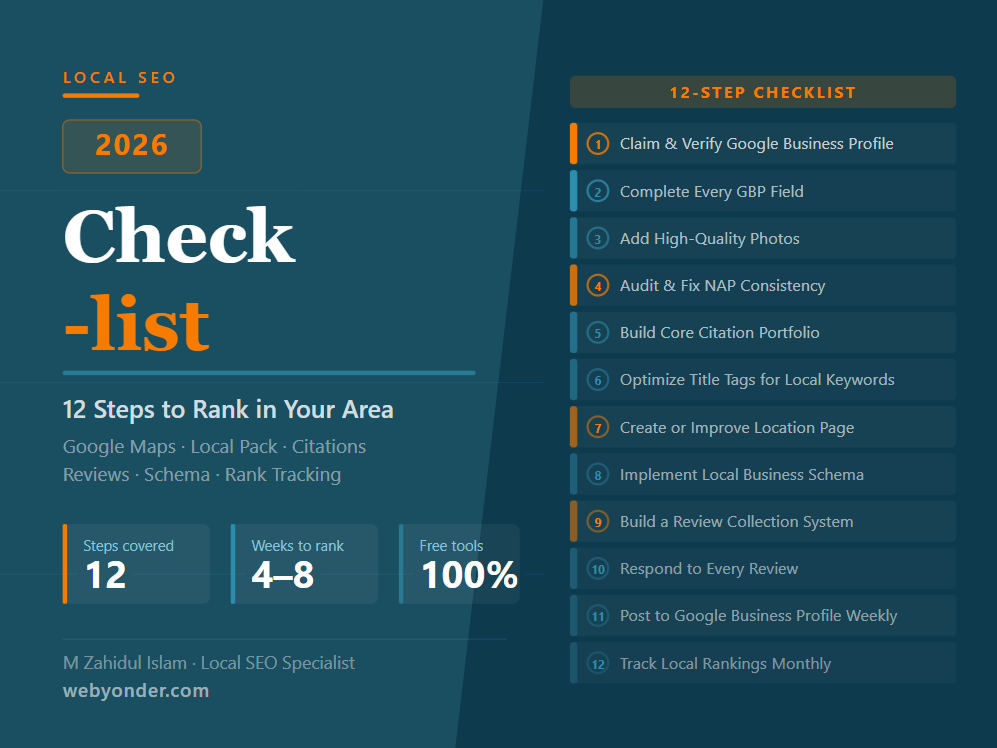
Most local SEO guides tell you what to do. This one tells you exactly what to do, in what order, and what good looks like at each step.
Bookmark this checklist. Work through it once to build your foundation, then revisit it quarterly to find what has slipped or what needs updating as your business grows.
Step 1: Claim and Verify Your Google Business Profile
Everything in local SEO flows from your Google Business Profile (GBP). If you have not claimed yours, go to google.com/business and claim it now. If it was already created automatically by Google, claim ownership through the verification process.
Verification typically happens via postcard, phone, or video. Until you are verified, you cannot edit your listing or respond to reviews — and Google will not rank an unverified profile with confidence.
What good looks like: Verified status confirmed inside your GBP dashboard. Green checkmark next to your business name.
Step 2: Complete Every Field in Your Google Business Profile
A half-completed GBP is a half-visible business. Google rewards profiles that provide complete, accurate information — and penalizes nothing faster than missing or inconsistent data.
Go through every available field:
- Business name (exactly as it appears on your signage and website — no keyword stuffing)
- Primary and secondary business categories
- Full address or service area
- Local phone number (not a toll-free number)
- Business hours including special holiday hours
- Website URL
- Business description (750 characters, factual, location and services included)
- Products and services with descriptions and pricing where applicable
- Attributes relevant to your category (wheelchair accessible, women-owned, outdoor seating, etc.)
What good looks like: Profile completeness shown as 100% inside GBP. No empty fields in the primary information sections.
Step 3: Add High-Quality Photos and Videos
Photos are the first thing a potential customer sees after your business name and rating. They make or break the first impression before anyone reads a single word about your services.
Upload a minimum of 20 photos to start:
- Exterior shots (from the street, from the entrance)
- Interior shots (the space your customers experience)
- Team photos (real people, not stock)
- Work in progress and completed results
- Products or service deliverables where applicable
Add new photos at minimum once per month. GBP profiles with 100 or more photos consistently receive more views and direction requests than those with fewer than 10.
What good looks like: 20+ photos live on your profile. No stock images. At least one photo added in the past 30 days.
Step 4: Audit and Fix Your NAP Consistency
NAP stands for Name, Address, and Phone number. It must be identical everywhere your business appears online — your website, Google, Facebook, Yelp, Yellow Pages, and every other directory.
Even minor inconsistencies — “St” versus “Street,” a missing suite number, an old phone number from three years ago — send conflicting signals to Google and suppress your local rankings.
Run a NAP audit using BrightLocal or Whitespark. Export every citation found and compare each one against your master NAP. Fix every inconsistency before building new citations.
What good looks like: Identical business name, address, and phone number across all platforms. No duplicate listings on the same directory.
Step 5: Build Your Core Citation Portfolio
Once your NAP is consistent, build your presence across the directories that carry the most local authority weight.
Priority order:
- Google Business Profile (already done)
- Bing Places for Business
- Apple Maps Connect
- Facebook Business Page
- Yelp (if relevant to your category)
- Yellow Pages
- Foursquare
- Hotfrog
- Your local Chamber of Commerce directory
After the general directories, add 3 to 5 industry-specific directories. A dental clinic needs Healthgrades. A lawyer needs Avvo. A contractor needs Houzz. Research which directories your competitors appear in and match them.
What good looks like: Listed on all Tier 1 platforms with complete, consistent NAP. At least 3 industry-specific directory listings live.
Step 6: Optimize Your Website Title Tags for Local Keywords
Your website’s title tags are the single most influential on-page SEO element. Every page targeting local customers needs a title tag that includes the primary service and the city.
Structure to follow:
- Service + City + Brand:
Plumber in Mirpur, Dhaka | Rapid Fix Plumbing - Brand + Service + City:
City Dental — Family Dentist in Gulshan, Dhaka
Apply this to your homepage, your main services pages, and any location-specific pages. Avoid generic titles like “Home” or “Services” — they communicate nothing to Google or to searchers.
What good looks like: Every primary service page has a title tag under 60 characters containing the service keyword and city name.
Step 7: Create or Improve Your Location Page
Your location page is the owned asset that supports your GBP listing and captures organic local search traffic beyond what your GBP alone can reach.
A proper location page includes:
- H1 tag with your primary service and city
- Opening paragraph that addresses the customer’s problem in the context of your city
- Services described with local relevance (mention local conditions, regulations, or common problems where genuine)
- Testimonials and reviews from customers in that city — with names and neighborhoods where possible
- An embedded Google Map pointing to your exact location
- Your local phone number as a clickable link
- A clear call to action above the fold
If you serve multiple cities or neighborhoods, each needs its own page. Do not duplicate content across location pages and change only the city name — write each one specifically for that area.
What good looks like: A location page of 500 or more words, with embedded map, local testimonials, structured H1 and H2 headings, and a visible CTA.
Step 8: Implement Local Business Schema Markup
Schema markup is structured data code that tells Google exactly what your business is, where it is located, what it does, when it opens, and how to contact it. It removes ambiguity and enables Google to extract precise information directly from your site.
At minimum, implement LocalBusiness schema with:
- Business name, address, phone (matching your NAP exactly)
- Business type and category
- Opening hours
- Geo-coordinates (latitude and longitude)
- Service area
- URL and logo
Use Google’s Rich Results Test to verify your schema is implemented correctly after publishing. This is one of the highest-leverage technical steps in local SEO — and one that most competitors have skipped.
What good looks like: LocalBusiness schema validates without errors in Google’s Rich Results Test. Geo-coordinates are accurate.
Step 9: Build a Review Collection System
Reviews are not a vanity metric. They are a direct local ranking signal and the primary trust mechanism a new customer uses before contacting your business.
The most effective review collection system has three components:
The ask: After every completed job or positive customer interaction, send a direct request. Use a short message with a single direct link to your Google review form. Remove all friction — one link, one action.
The timing: Ask within 24 to 48 hours of service completion while the experience is fresh. Requests sent after a week see significantly lower response rates.
The consistency: One campaign generates a spike. A system generates a steady monthly flow. Assign review follow-up as a fixed part of your post-service process, not a periodic push.
What good looks like: A minimum of 5 new reviews per month. Review recency shows reviews posted within the last 30 days. Average rating of 4.3 or above.
Step 10: Respond to Every Review Within 48 Hours
Google monitors your review response rate. Customers read your responses before deciding whether to contact you. Both audiences — Google and humans — reward businesses that engage.
For positive reviews: Thank the reviewer by name. Reference something specific about their experience. Keep it to two or three sentences. Avoid copy-paste templates — they read as dismissive.
For negative reviews: Respond calmly and factually. Acknowledge the concern without admitting fault where it is not warranted. Offer a direct resolution path offline (phone number or email). Never argue publicly.
What good looks like: 100% response rate to all reviews. No review older than 7 days without a response. Responses personalized, not templated.
Step 11: Post to Google Business Profile Weekly
GBP posts are one of the most underused features in local SEO. They keep your profile active, give Google fresh content signals, and give potential customers a reason to choose you over a competitor with a dormant profile.
Post once per week. Content ideas that work:
- Completed project photos with a brief description
- Seasonal promotions or limited-time offers
- Answers to common customer questions
- New service announcements
- Community involvement or local event participation
Keep posts between 100 and 300 words. Include a call to action — “Call now,” “Book online,” “Get a free quote.” Posts expire after seven days, so consistency is the only way to maintain fresh content.
What good looks like: At least one GBP post per week. No gap longer than 10 days between posts. Each post includes an image and a CTA.
Step 12: Track Your Local Rankings Monthly
A local SEO effort without measurement is guesswork. You need to know whether your rankings are moving, which keywords are improving, and where the next highest-leverage action lies.
Track these metrics every 30 days:
Local Pack rankings: Use BrightLocal or Local Falcon to track your position for 10 to 15 target keywords at the city and neighborhood level. Track at grid level — your rank at the center of your city may differ significantly from your rank three kilometers away.
GBP Insights: Monitor searches (how people found your profile), views, clicks to website, direction requests, and phone calls. Month-over-month growth in direction requests and calls is your most reliable proxy for real business impact.
Google Search Console: Filter clicks from location-modified keywords. Track whether local organic traffic is growing consistently with your optimization effort.
Review velocity: Total reviews, monthly new reviews, and average rating. This should trend upward every month.
What good looks like: A simple monthly tracking spreadsheet with all four data sets. Clear direction (improving, stable, or declining) on each metric. A defined action triggered when any metric declines for two consecutive months.
Your 2026 Local SEO Checklist at a Glance
| Step | Action | Priority |
|---|---|---|
| 1 | Claim and verify Google Business Profile | Critical |
| 2 | Complete every GBP field | Critical |
| 3 | Add 20+ real photos | High |
| 4 | Audit and fix NAP consistency | Critical |
| 5 | Build core citation portfolio | High |
| 6 | Optimize title tags for local keywords | High |
| 7 | Create or improve location page | High |
| 8 | Implement LocalBusiness schema markup | Medium |
| 9 | Build a review collection system | Critical |
| 10 | Respond to every review within 48 hours | High |
| 11 | Post to GBP weekly | Medium |
| 12 | Track local rankings monthly | High |
Frequently Asked Questions
How long does it take to see results from a local SEO checklist?
Steps 1 through 5 — GBP optimization and NAP consistency — typically show ranking movement within 4 to 8 weeks. Full results from the complete checklist, including review velocity and schema, usually compound over 3 to 6 months.
Do I need to complete all 12 steps to see results?
No. Steps 1, 2, 4, and 9 alone will outperform most competitors who have never done any of this intentionally. Each additional step compounds the results from the ones before it. Start with the critical steps and work through the rest systematically.
How often should I revisit this checklist?
Work through the full checklist once when building your foundation. After that, run a quarterly audit to check NAP consistency, photo recency, GBP post activity, review velocity, and ranking movement. Spot and fix drift before it compounds into ranking loss.
What is the single most impactful step for a new business?
Claiming and fully completing your Google Business Profile delivers the fastest visible results. In low-to-medium competition markets, a fully optimized GBP alone can produce Local Pack appearances within 30 to 60 days.
Is local SEO different for service-area businesses that do not have a physical storefront?
Yes. Service-area businesses should set a service area in GBP instead of a physical address (or hide the address). The same checklist applies, but location page content becomes even more important since proximity signals from a fixed address are absent.
What to Do Next
This checklist gives you the complete roadmap. The difference between businesses that rank and businesses that do not is not knowledge — it is consistent execution.
If you have worked through this checklist and want a professional audit of where you currently stand in local search, a structured local SEO review will identify the gaps fastest and prioritize exactly where your effort should go next.
Written by M Zahidul Islam — Local SEO Specialist & AI Visibility Expert. Helping service businesses and multi-location brands build resilient local search ecosystems. Visit webyonder.com/local-seo/ for a full local SEO service overview.