
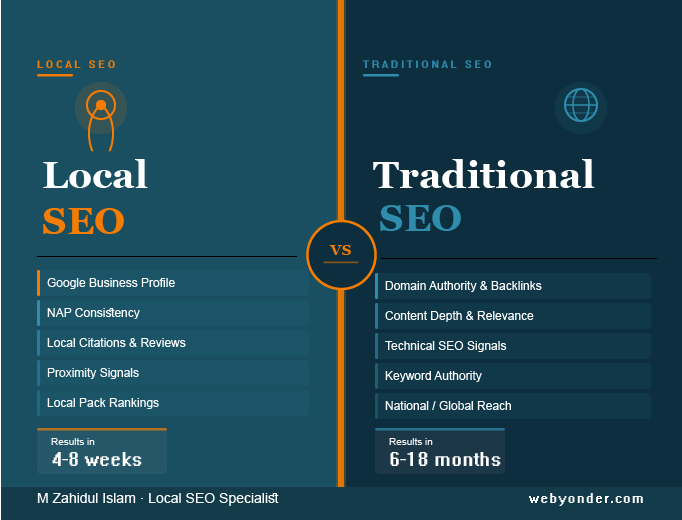
Every business that searches for SEO help eventually hits the same wall: two strategies, similar-sounding names, very different outcomes. Understanding which one your business needs — and why — is the difference between a strategy that compounds and money spent on the wrong signals.
This guide breaks down exactly how local SEO and traditional SEO differ, where they overlap, and which one your business should be prioritizing right now.
What Is the Core Difference?
Traditional SEO (also called organic SEO) is the practice of optimizing a website to rank for keywords across a national or global audience. It is primarily about earning authority through content, backlinks, and technical performance — with no geographic targeting required.
Local SEO is the practice of optimizing your online presence to appear in search results when people search for services in a specific geographic area. It targets location-specific queries and leverages tools like Google Business Profile, citations, and local reviews to rank in a defined city, neighborhood, or region.
The same goal — visibility on Google — but the mechanism, the signals, the tools, and the competition are fundamentally different.
How Google Treats Each Search Differently
Understanding the difference starts with understanding how Google interprets two distinct types of search intent.
When someone searches “best project management software,” Google infers no location. It returns national or global results ranked primarily by content authority, domain strength, and relevance. This is traditional organic search territory.
When someone searches “dentist near me” or “plumber in Gulshan,” Google infers geographic intent. It activates the local search algorithm — a separate ranking system — and returns a map-based Local Pack alongside organic results. The signals that drive these rankings are entirely different from what drives standard organic rankings.
The trigger for local results is either an explicit location in the query (“in Dhaka”) or implicit location intent (“near me,” or category searches Google associates with local need, such as “restaurant,” “repair shop,” or “clinic”). Once that trigger is active, the local algorithm takes over — and that algorithm cares about signals that traditional SEO simply does not use.
The Ranking Signals: Side by Side
This is where the practical difference becomes clear.
Traditional SEO Ranking Signals
Domain authority and backlinks sit at the center of traditional SEO. A website earns authority by receiving links from credible external sites. The more high-quality links pointing to a site, the more Google trusts it as an authoritative source. Building this authority takes months to years.
Content depth and relevance matter significantly. Traditional SEO rewards comprehensive, well-structured content that covers a topic thoroughly — articles, guides, comparison pages, and resource hubs that serve informational, navigational, and transactional search intent at scale.
Technical SEO — site speed, crawlability, Core Web Vitals, mobile performance, structured data — determines whether Google can access, understand, and efficiently rank a site’s content.
Keyword strategy in traditional SEO targets terms with national or global search volume, often competitive head terms and informational long-tail queries. The battleground is domain vs. domain across millions of searches.
Local SEO Ranking Signals
Google Business Profile optimization is the primary local ranking asset. Google’s local algorithm reads the completeness, accuracy, category selection, photo volume, review quality, and posting activity of a GBP as core signals of relevance and prominence.
NAP consistency — the uniformity of a business’s Name, Address, and Phone number across all online directories and platforms — is a local-specific signal with no equivalent in traditional SEO. Inconsistent NAP data directly suppresses local rankings.
Review signals — the volume, recency, rating, and keyword content of Google reviews — are direct ranking factors in local search. A business with 80 recent four-star reviews outperforms a competitor with 12 older reviews, all else being equal.
Local citations — mentions of your business across directories, industry platforms, and local media — reinforce your business’s legitimacy and geographic relevance. These function as a lower-complexity alternative to traditional link building for local visibility.
Proximity — how close your business is to the searcher’s location — is a factor in local rankings that has no parallel in traditional SEO. You cannot optimize your way out of geography, but you can strengthen the other signals to rank beyond your immediate block.
The Competition Landscape
Traditional SEO is global competition. If you run a software blog, you compete against every other software blog that has ever published content on that topic — including sites with ten years of domain authority and thousands of backlinks. Breaking through requires sustained content investment and long-term link building.
Local SEO competes within a defined radius. Your direct competitors are the businesses in your city or neighborhood that offer the same service. That pool is dramatically smaller — and more beatable. A well-run independent dental clinic can outrank a national dental chain in its own neighborhood through better local optimization, even with a fraction of the larger brand’s domain authority.
This is why local SEO typically delivers faster, more directly measurable business results for service-area businesses. The competition ceiling is lower. The intent is higher. The conversion from search to customer is more direct.
The Tools Are Different Too
| Purpose | Traditional SEO Tools | Local SEO Tools |
|---|---|---|
| Keyword research | Ahrefs, SEMrush, Google Search Console | Ahrefs (local volume), Google Keyword Planner |
| Rank tracking | Ahrefs, SEMrush, Moz | BrightLocal, Local Falcon, GeoRanker |
| Technical audits | Screaming Frog, Sitebulb | Screaming Frog + schema validators |
| Link building | Ahrefs backlink tools, HARO | BrightLocal, Whitespark |
| Citation management | Not applicable | BrightLocal, Whitespark, Yext |
| Review management | Not applicable | BrightLocal, GBP dashboard, ReviewTrackers |
| GBP management | Not applicable | Google Business Profile dashboard |
The overlap is real — both disciplines use keyword research, technical audit tools, and content optimization. But local SEO requires an entirely separate set of tools and workflows that traditional SEO practitioners rarely use or understand deeply.
Timeline to Results
Traditional SEO timelines are long. A new domain targeting competitive national keywords realistically needs 6 to 18 months before meaningful organic traffic appears. Building domain authority through content and links is a slow, compounding process with no shortcut.
Local SEO moves faster. A business that fully optimizes its Google Business Profile, fixes NAP inconsistencies, and builds initial review volume can see Local Pack appearances within 4 to 8 weeks in low-to-medium competition markets. More competitive city markets take 3 to 6 months for stable top-three Local Pack positioning.
The reason for the speed difference: local SEO has a lower authority threshold for visible results. You are not competing against national domains with years of link equity. You are competing against local businesses, many of which have done minimal optimization.
Intent and Conversion Rate
Search intent differs significantly between local and traditional organic searches — and that difference directly affects conversion rates.
A person searching “what is SEO” is seeking information. They are unlikely to make a purchase immediately. This is the typical intent landscape of traditional organic search — informational, educational, researching.
A person searching “SEO agency in Dhaka” or “emergency plumber near me” is ready to contact a business. The intent is transactional and immediate. Local search queries carry a disproportionately high purchase intent compared to standard organic keywords.
This is why local SEO typically delivers a better cost-per-acquisition than traditional content SEO for service businesses. The traffic is smaller in volume but significantly more qualified at the point of conversion.
Where They Overlap
Local SEO and traditional SEO are not entirely separate disciplines. They share a foundation, and businesses that execute both well gain compounding advantages.
On-page SEO applies to both. Title tags, meta descriptions, heading structure, page speed, mobile performance, and internal linking all matter for local ranking and organic ranking simultaneously. A well-built location page earns local rankings and can rank organically for city-specific searches.
Content supports both. Blog content on local topics — guides about local regulations, neighborhood-specific advice, locally relevant comparisons — earns organic rankings and reinforces local topical authority.
Technical SEO underpins both. Schema markup, crawlability, and Core Web Vitals affect how Google processes your site regardless of whether the ranking goal is local or national.
Backlinks help both. Local links from local news sites, community organizations, and industry directories support both GBP prominence and traditional domain authority.
Which Strategy Does Your Business Need?
The answer depends on how your customers find you.
Prioritize Local SEO if:
- Your customers are in a specific city, neighborhood, or region
- Your business requires physical proximity — customers come to you or you go to them
- You are in a service category where Google shows a Local Pack (restaurants, clinics, lawyers, contractors, agencies)
- You want results in weeks rather than months
- Your primary conversion goal is a phone call, direction request, or appointment
Prioritize Traditional SEO if:
- Your product or service is sold nationally or globally
- You operate entirely online without geographic constraints
- Your primary goal is informational content reach, lead generation at scale, or e-commerce traffic
- You are building a content-driven brand that competes on knowledge authority
Invest in both if:
- You serve local clients but also want to build topical authority through content (a local SEO agency, a regional law firm, a multi-location service brand)
- You want to protect long-term organic rankings while dominating your local market now
- You are ready to treat SEO as a compounding system rather than a one-time project
Most service businesses that focus exclusively on traditional SEO tactics — link building, content production — and ignore their Google Business Profile are leaving their most direct customer acquisition channel untouched.
Frequently Asked Questions
Is local SEO better than traditional SEO?
Neither is universally better. Local SEO is more effective for businesses serving a specific geographic area. Traditional SEO is more effective for businesses competing at national or global scale. The right answer depends entirely on how and where your customers find you.
Does a local business need traditional SEO?
Yes, to a degree. Local businesses benefit from solid on-page SEO, fast-loading websites, and content that supports their local authority. However, the highest-leverage investment for most local businesses is Local SEO — GBP, citations, and reviews — before investing heavily in content-driven traditional SEO.
Can I rank locally without a website?
A fully optimized Google Business Profile can appear in Local Pack results without a website. However, a website significantly strengthens local rankings by providing additional relevance signals, location page content, and schema markup.
Which is more competitive — local SEO or traditional SEO?
Traditional SEO is considerably more competitive in most niches. Local SEO competes within a defined geographic radius against a smaller pool of businesses, making it more accessible for businesses with limited budgets and time.
How do the costs compare?
Traditional SEO at scale — content production, link building, technical infrastructure — typically requires a larger ongoing investment. Local SEO can produce significant results with focused effort on GBP, citations, and reviews, making it the higher ROI starting point for most small service businesses.
The Bottom Line
Local SEO and traditional SEO answer different questions. Traditional SEO answers: “Can people across the country or globe find this website?” Local SEO answers: “Can people in my city find this business when they are ready to buy?”
If you run a service business and your customers are within a 20-kilometer radius, local SEO is not just one option among many. It is your primary acquisition channel — and it deserves to be treated as one.
Understanding the difference is the first step. Building a strategy that executes on the right signals, in the right order, is what separates businesses that appear when customers are ready from businesses that remain invisible at the exact moment that matters most.
Written by M Zahidul Islam — Local SEO Specialist & AI Visibility Expert. Helping service businesses and multi-location brands build resilient search ecosystems. Visit www.webyonder.com/local-seo/ for a full local SEO service overview.